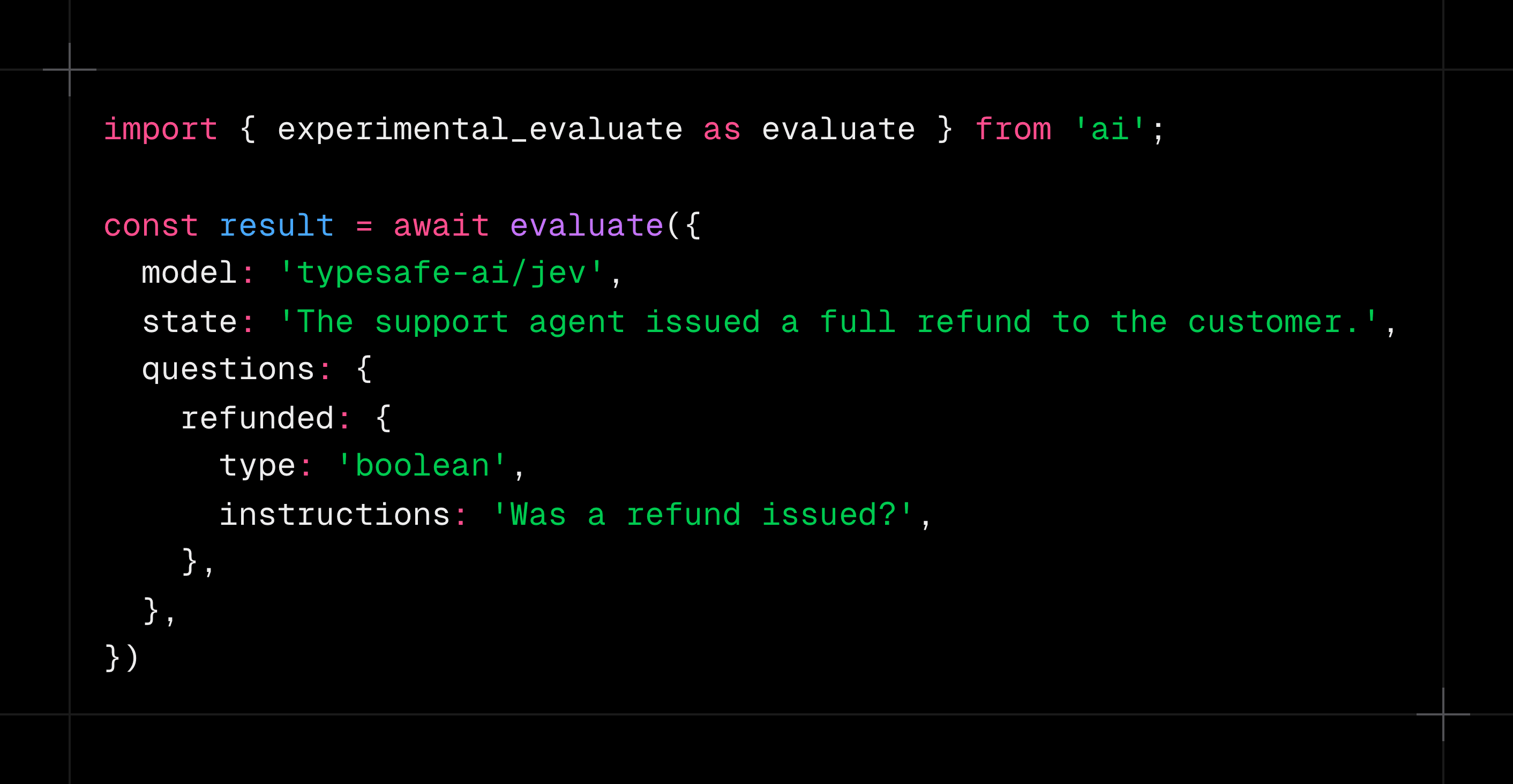
Jev has attracted an absolute ton of attention really quickly. Vercel says it had the fastest adoption of any model launched on its AI Gateway.
I can see why people are excited. A lot of marketing & AEO work involves reading something, deciding what it means, and putting it in the right place. Sometimes thousands of times.
That is the kind of work Jev could help with.
What the heck actually is Jev?
Jev is an AI model from TypeSafe.
You give it information, a specific question and a defined set of possible answers.
It returns a structured result with probabilities, which software can use to decide what happens next.
What?
Okay, an SEO example: give it a search query like “best running shoes for flat feet” and ask it to choose an intent category: learning, comparing products, buying or unclear. Your workflow can use that classification to group keywords for you to review and map to the right pages.
It can also score information against criteria you provide, or estimate whether a statement is true. The TypeSafe introduction explains these building blocks.
TypeSafe calls this a System One model, borrowing the idea of fast, intuitive judgements from Daniel Kahneman.
It is designed for focused decisions. I actually think it's not a good idea to compare it to LLMs, it just complicates things. It does not write articles, generate code or explain its reasoning.
Why is this interesting?
We could already ask language models to classify things. The interesting part is having a model built specifically for that job.
Jev evaluates independent questions in parallel. TypeSafe reports substantial speed and cost improvements in its launch article, although those are its own evaluations, and your results will depend on the workload.
If those savings hold up, it becomes practical to add useful judgement to processes that previously needed too much manual attention. That is a pretty exciting prospect for marketing teams with more data than time.
Where I would look for marketing opportunities
These are applications I want to test, rather than stuff I've already done. I wish I had a little more time!
Making customer feedback useful
Reviews, survey responses and sales call transcripts contain information we should be using. They also tend to sit in different places, largely unread.
I would test Jev against categories such as price objections, missing features and confusion about the product, with room for unclear cases. Count the patterns, then read the original comments behind them.
That could give you a much better starting point for a landing page brief than another look at what competitors are writing.
Sorting search queries
Give Jev search queries alongside your products, audiences and definitions of intent. Ask it to classify each query and flag possible mismatches.
For SEO, that could help organise research into useful groups. For paid search, it could help prioritise terms for review. I would still want someone checking before a suggested mismatch became a negative keyword.
The definitions matter. A model cannot make your commercial priorities clear if you haven't done that yourself.
Getting enquiries to the right person
A form submission rarely arrives neatly labelled. Someone might ask about pricing whilst also describing a technical problem.
Jev could assess those needs separately, helping your workflow route the enquiry or flag it for review. Vercel's guide to when to use Jev is useful here: interpretation belongs with the model; business rules and actions stay in your software.
A structured answer can still be wrong
Be careful with the claim that Jev cannot hallucinate. Its output is constrained to the format and options you define. It can still choose the wrong option.
And its confidence score is not a guarantee of accuracy. Vercel's explanation of probabilities and thresholds is worth reading before automating decisions.
I would start with one repetitive task, compare Jev's answers with examples a person has checked, and measure mistakes alongside time saved. Keep a review route for uncertain cases.
Cheers, Jev
If this works as well as we hope, we could spend a lot less time sorting data and a lot more time doing something useful with it. Unfortunately, “I’m still working through the spreadsheet” has been an excellent excuse, and I will miss it.